Authorization Setup
This page documents setupAuthorizationForExpress - the systems-level entry point for the v4 authorization subsystem. It complements the Guards & Authorization page (which covers per-route decorators).
Overview
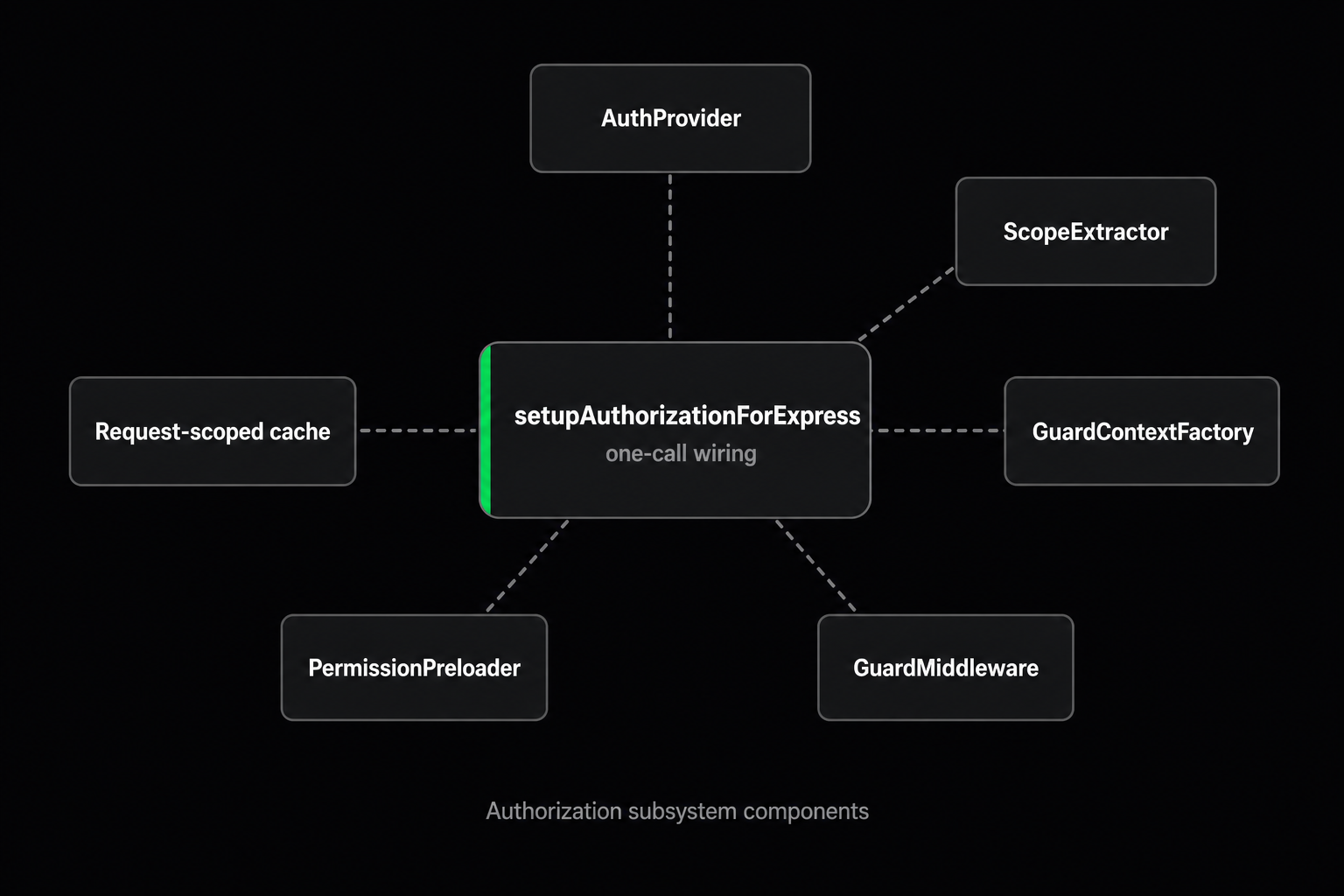
setupAuthorizationForExpress registers, in one call, every component the authorization pipeline needs:
| Component | Why it is registered |
|---|---|
setupAuthorization (core) | Permission service, hierarchy, request-scoped cache. |
ScopeExtractor | Pulls request, tenant, user scope out of the Express request. |
GuardContextFactory | Builds the GuardContext consumed by every guard. |
GuardMiddleware | Per-route guard executor wired into Express. |
PermissionPreloaderMiddleware (optional) | Eagerly resolves a user's permissions per request. |
Your AuthProvider | The thing that knows how to authenticate a request. |
Quick start
import { AppExpress, setupAuthorizationForExpress } from "@expressots/adapter-express";
import { MyAuthProvider } from "./auth/my-auth-provider";

export class App extends AppExpress {
  async configureServices(): Promise<void> {
    setupAuthorizationForExpress(
      this.config.Container,
      {
        enablePreloading: true,
        enableCaching: true,
        permissionHierarchy: {
          "super-admin": ["admin", "moderator", "user"],
          admin: ["moderator", "user"],
          moderator: ["user"],
        },
      },
      this.Middleware,
      MyAuthProvider,
    );
  }
}
Configuration shape (AuthorizationConfig)
| Option | Type | Default | Purpose |
|---|---|---|---|
enablePreloading | boolean | true | Mount the preloader middleware so guards never re-resolve permissions. |
enableCaching | boolean | true | Use the request-scoped permission cache. |
permissionHierarchy | Record<string, string[]> | {} | Implicit permissions inherited by higher roles. |
policies | Record<string, PolicyFn> | {} | Named ABAC policies referenced by RequirePolicy("name"). |
errorOnMissingScope | boolean | false | Throw if ScopeExtractor cannot resolve a tenant/user. |
The AuthProvider contract
import type { AuthProvider, Principal } from "@expressots/adapter-express";

export class MyAuthProvider implements AuthProvider {
  async authenticate(req: import("express").Request): Promise<Principal | null> {
    const token = req.headers.authorization?.replace(/^Bearer /, "");
    if (!token) return null;

    const user = await verifyJwt(token);
    return {
      id: user.id,
      details: user,
      isAuthenticated: () => true,
      isInRole: (role) => user.roles.includes(role),
    };
  }
}
Pass this class as the fourth argument of setupAuthorizationForExpress; the helper binds it to TYPE.AuthProvider for you.
Preloading vs lazy resolution
- Preloading on (default): one resolution per request, cached for every guard.
- Preloading off: each guard pays the resolution cost the first time it asks. Useful when only a small fraction of routes is guarded.
Permission hierarchy in practice
permissionHierarchy: {
  admin: ["moderator", "user"],
  moderator: ["user"],
}
A user with permission admin is treated as if they also held moderator and user. Hierarchies do not need to be a tree; cycles are detected and rejected at startup.
Pairing with route decorators
setupAuthorizationForExpress is the systems wiring. Per-route enforcement is described in Guards & Authorization:
@controller("/api/users")
export class UserController {
  @Get("/profile") @RequireAuthentication() getProfile() { ... }
  @Get("/admin")  @RequireRoles("admin") admin() { ... }
  @Get("/edit")   @RequirePermissions("user.edit") edit() { ... }
  @Get("/owned/:id") @RequireOwnership("id") mine() { ... }
}
Common pitfalls
| Symptom | Cause | Fix |
|---|---|---|
principal is always undefined in handlers | setupAuthorizationForExpress not called, or called after Middleware.add(...). | Call it inside configureServices() before registering domain middleware. |
| 403 on routes you expect to pass | Permission name typo, or permissionHierarchy is missing a parent role. | Log principal.details.permissions once and align with hierarchy. |
| Auth provider runs twice per request | enablePreloading disabled and the same guard re-evaluated. | Re-enable preloading or attach the cache decorator on the guard. |
IScopeExtractor not bound at startup | Setup helper not called or container snapshotted before setup. | Call setupAuthorizationForExpress first; do not snapshot the container too soon. |
See also
- Guards & Authorization - per-route decorators (
@RequireRoles,@RequirePermissions,@RequireOwnership,RequirePolicy). - Middleware - how the preloader fits in the middleware chain.
- Interceptors - cross-cutting logging or audit trails around guard execution.